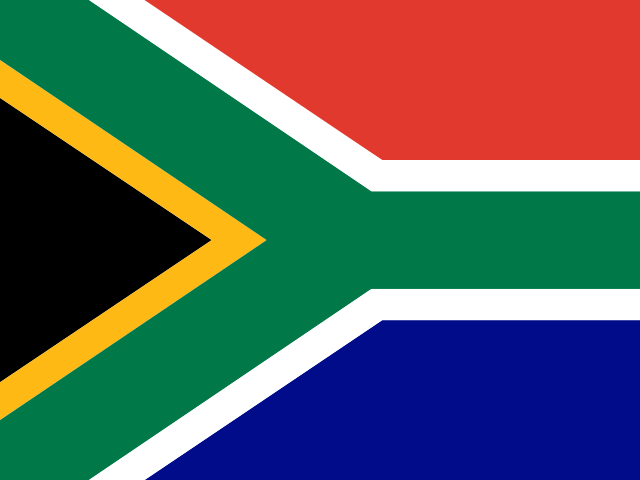






























How much does South Africa drink?
Alcohol consumption per adult, per year
litres of pure alcohol per adult (15+), per year
Per adult, that is roughly:
95% above the regional average
South Africa
Calculate your estimated Blood Alcohol Concentration (BAC) instantly. Track standard drinks, view your sobriety curve, and check your status against South Africa's 0.05% legal driving limit.
Do you fancy AI? Try our AI-powered BAC calculator.
Section 65 of the National Road Traffic Act sets 0.05 g/100 ml blood (0.24 mg/1 000 ml breath) for ordinary drivers and 0.02 g/100 ml for Professional Driving Permit holders. A 0.00% zero-tolerance limit has been signed into law under the National Road Traffic Amendment Act but is not yet in force.
| {{ afterLabel }} | {{ $t('unit.' + units) }} | Status |
|---|---|---|
| {{ result.time }} | {{ result.drunkenness }} |
Your estimated BAC as your body clears the alcohol
{{ $t('impact.limit_note', { limit: impactLimitLabel }) }}
{{ $t('impact.disclaimer') }}
💡 Tips: drink water, eat, and avoid driving until below the legal limit and ideally sober.
Your Current BAC is the estimated concentration of alcohol in your blood, shown as a percentage. South African law sets the limit in grams per 100 ml of blood (and micrograms in breath); 0.05% is the same as 0.05 g per 100 ml — the reading an evidential test works to.
Under Section 65 of the National Road Traffic Act, ordinary licence holders must stay under 0.05 g/100 ml (0.05% BAC), and Professional Driving Permit (PrDP) holders under 0.02 g/100 ml. Drink-driving is a criminal offence: you can be arrested at the roadblock and a conviction leaves a permanent criminal record. A 0.00% zero-tolerance limit has been signed into law but is not yet in force.
Alcohol leaves the body at a steady pace of roughly 0.015% an hour, and nothing on the internet changes it. A cold shower, strong coffee or a plate of food may make you feel sharper, but your actual reading comes down only with time — which is why you can still be over the limit the next morning.
A standard drink is counted as about 10 grams of pure alcohol. Local servings carry more: a 340 ml “dumpy” of 5% beer is roughly 1.3 standard drinks and a 750 ml “quart” about 3, while a home pour of wine or a tot of spirits is around one. This total adds them up for you.
The pure alcohol (in grams) your body has absorbed so far — the basis for both your standard-drink count and your BAC.
The table projects your BAC each hour. Enter the time of your first drink and the estimates line up with the time of day, so you can see when you should fall back under 0.05% (or 0.02% on a PrDP). Status icons mark the hours that are safe to drive; leave it blank to work in hours elapsed.
A line chart of your BAC dropping over the hours ahead, showing when it passes below the legal limit and below a genuinely safe level.
A reference table linking BAC ranges to their typical effects on judgement, coordination and reaction time — impairment that begins well before the legal limit.
Quick summary estimates:
Legal limit reached in: time until your BAC drops below the applicable limit (0.05% or 0.02% PrDP).
Sober in: time until it returns to ~0.000%.
Peak BAC: the highest level reached in the session.
Five factors that determine your result
Alcohol consumption per adult, per year
litres of pure alcohol per adult (15+), per year
Per adult, that is roughly:
95% above the regional average
Road traffic deaths per 100,000 people, per year
road traffic deaths per 100,000 people, 2021
26% more road deaths than the regional average
Latest available year shown per country.
Explore the legal blood alcohol concentration (BAC) limits for drivers in neighbouring countries.
Legal BAC limits for drivers in South Africa
Consequences of exceeding South Africa's 0.05 g/100ml limit (0.02 g/100ml for professional drivers)
Practical tips for safer drinking
The limits and penalties on this page come from official government sources
Confirm the current rules directly with the responsible authorities:
Laws change — always check the latest limits and penalties with the official source before driving.
The exact formula, step by step
Your result is not a guess. It comes from the Widmark equation, the same formula forensic toxicologists use in court. Here it is, worked through with an example.
BAC = A ÷ (r × W) − (β × t)
where A = grams of pure alcohol, r = body-water factor (0.68 for men, 0.55 for women), W = weight in kg, β = elimination rate (~0.15 g/L per hour), and t = hours since your first drink.
The calculator runs this same equation on your own weight, sex, drinks and timing — the numbers above are only a worked example. Method based on E. M. P. Widmark (1932); results are an estimate, not a legal measurement.
SmartBAC has run over 17,000 calculations in recent weeks. Of every drink people log, beer is the most common by far — about 6 in 10 — ahead of spirits and then wine.
Anonymous, aggregated first-party usage data from SmartBAC, July–August 2026.
As a rough guide, your body clears alcohol at about 0.015% BAC per hour, and this pace cannot be hurried. A single standard drink takes roughly an hour to process, so a heavy night takes a long time to clear: if you go to sleep with a BAC around 0.15%, it can take 10 hours or more to return to zero. This is exactly why so many drivers are caught the morning after, still over the limit on the way to work.
How long alcohol stays detectable also depends on the test. In breath and blood it tracks your current BAC and fades over hours; in urine, specialised tests can detect it for a day or more; and hair testing can indicate use over months. Whether you drank beer, wine or spirits makes little difference once you account for the total alcohol — what matters is how many grams you drank, not the type. For driving, the figure that counts is your current BAC, and the only safe number before getting behind the wheel is 0.00%. Use the calculator to estimate your own time to zero.
The honest answer is that you cannot actively lower your BAC — only time does that. Once alcohol is in your bloodstream, the liver removes it at a steady rate of roughly 0.015% per hour, and no trick changes that pace. Vomiting may clear alcohol that is still in your stomach and not yet absorbed, but it does nothing about the alcohol already in your blood. Water helps with dehydration and hangover symptoms, but it does not "flush" or dilute alcohol out of your system any faster.
Coffee, cold showers, energy drinks, fresh air and exercise are all in the same category — they may make you feel sharper, but your BAC is unchanged, which makes them genuinely dangerous if they convince you that you are fit to drive. There is no shortcut. If your BAC is up, the only safe plan is to wait it out and not drive until enough time has passed.
No breathalyser is perfectly precise — every device has a margin of error. Officers know this: roadside units are a screening tool, and any positive result is meant to be confirmed with a more accurate evidential test on a calibrated instrument, which is what carries weight as evidence.
Personal breathalysers vary enormously in quality. A certified fuel-cell device can give a reasonable indication, but a cheap keychain tester can be wildly inaccurate and should never be used to decide whether you are fit to drive. Readings also drift if a device is not regularly calibrated, or if you test too soon after a drink, when mouth alcohol can inflate the result. Treat any personal device as a rough guide only — if a reading is anywhere near the limit, the safe choice is not to drive.